

Reading Time: est. 16 minutes
On this page
The best books on self-awareness include Insight by Tasha Eurich (the most research-backed), Emotional Intelligence by Daniel Goleman, Daring Greatly by Brené Brown, and The Untethered Soul by Michael Singer. Tasha Eurich’s research found that 95% of people believe they are self-aware, but only 10–15% actually are— which means most of us need both the right books and the right approach to develop this skill. The books below are organized by dimension of self-awareness, so you can find the best starting point based on where you are and what you’re trying to understand.
At a Glance
| Book | Best for |
|---|---|
| Insight by Tasha Eurich | Understanding self-awareness as a researchable skill |
| Emotional Intelligence by Daniel Goleman | Foundational EI model, professional context |
| Emotional Agility by Susan David | Getting unstuck from unhelpful emotions |
| Permission to Feel by Marc Brackett | Learning to name and work with emotions accurately |
| Mindset by Carol Dweck | Surfacing hidden beliefs about ability and identity |
| Daring Greatly by Brené Brown | Understanding how shame and vulnerability shape behavior |
| The Body Keeps the Score by Bessel van der Kolk | Body self-awareness, nervous system patterns |
| The Untethered Soul by Michael Singer | Observing thoughts and emotions without being absorbed by them |
| A New Earth by Eckhart Tolle | Recognizing unconscious ego patterns, spiritual layer |
What Self-Awareness Actually Is (and Why Most Books Get It Wrong)
Self-awareness is the ability to see yourself clearly— both how you see yourself internally and how others experience you. Most books on the topic treat it as a single thing. Tasha Eurich’s research reveals it’s actually two distinct, uncorrelated skills.
Most of us can recall a moment when we reacted in a way that surprised us afterward. Anger that came out sideways. A choice we couldn’t explain. That gap between what we think we know about ourselves and what’s actually driving us is exactly what these books address.
According to Tasha Eurich’s research, 95% of people believe they are self-aware, but only 10–15% actually meet the criteria in her multi-year study spanning nearly 5,000 participants. As she and her team define it: “Self-awareness is the ability to see ourselves clearly— to understand who we are, how others see us, and how we fit into the world.” That’s a much harder bar than most of us realize.
Eurich’s framework from Insight (2017) identifies two distinct dimensions:
- Internal self-awareness— Knowing your own values, emotions, patterns, and reactions
- External self-awareness— Knowing how others actually experience you
Here’s what makes this useful: the two dimensions don’t correlate. Someone can have sharp internal self-awareness and still be blind to how they land on other people. And vice versa. Different books develop each.
One more distinction worth making before we get to the list. Self-awareness (the real-time skill of seeing what’s happening inside you), self-discovery (the longer journey of understanding your values and calling), and self-improvement (changing habits and behavior) are related but different. Conflating them is why people can feel like they’ve already “done the work” and still get stuck. Books in this list develop self-awareness specifically.
Start with Insight if you want the research foundation— it’s the book that establishes the whole field.
Books for Understanding Self-Awareness as a Skill
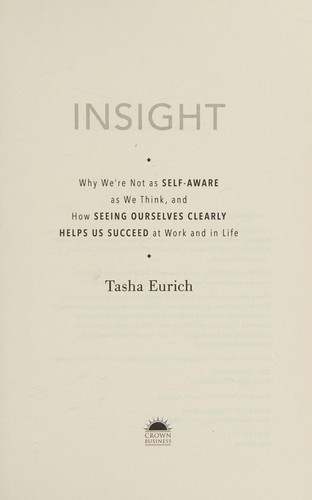
Insight by Tasha Eurich is the most research-grounded book on self-awareness available— built on a multi-year research program reviewing approximately 800 scientific studies and studying nearly 5,000 participants.
As Eurich writes in Insight: “Although we humans are the preeminent self-knowing species, most of us don’t know ourselves nearly as well as we think we do.” The book investigates why that gap exists and how to close it, structured around seven pillars of self-knowledge she identified through her research: values, passions, aspirations, fit, patterns, reactions, and impact.
But the most practically useful insight in the book is about introspection itself. Most people assume that reflecting on themselves is how you build self-awareness. Eurich found it’s more complicated than that. Asking “why” questions (“Why am I so anxious about this meeting?”) tends to generate stories, rationalizations, and narratives that feel true but aren’t necessarily accurate. Asking “what” questions (“What am I actually feeling right now?”) tends to produce more honest, useful data.
And most of us use “why.”
If you only read one book on self-awareness, this is it. It’s rigorous, it’s accessible, and it reframes the whole project of knowing yourself in a way that actually produces results.
Best for— Analytical readers, professionals, and anyone who wants a research foundation before investing time in the practices.
But if you want to go deeper into how emotions work (where most self-awareness gaps actually show up), these three books go further.
Books for Emotional Self-Awareness
If self-awareness has a home base, it’s your emotional life— and these three books give you three distinct tools for understanding what’s happening there.
Emotional Intelligence by Daniel Goleman

Self-awareness is the foundational, first competency in Daniel Goleman’s five-component model of emotional intelligence. For Goleman, self-awareness is the keystone of emotional intelligence. He defines it as recognizing a feeling as it happens— before you act on it. All the other EI skills build on it: self-regulation, motivation, empathy, social skills. You can’t manage what you haven’t first noticed.
Emotional Intelligence was published in 1995 and remains the foundational text in this space. Newer EI research has expanded the model, but Goleman’s original framework is still the clearest place to start. It’s especially strong for readers in professional or career contexts who want to understand why emotional literacy matters at work.
Best for— Professionals and career-focused readers who want the foundational EI model. You can also take an emotional intelligence test to get a baseline before or after reading.
Emotional Agility by Susan David
Emotional Agility by Harvard Medical School psychologist Susan David teaches a skill that most people haven’t been explicitly taught: how to detach from your emotions without suppressing them.
David identifies two failure modes that look opposite but both reflect low self-awareness. “Bottling” means pushing emotions down until the pressure leaks out in unexpected ways. “Brooding” means over-identifying with your emotions— replaying and rehearsing until you’re stuck in them. Neither is the same as actually seeing what’s happening.
Think about the last time you felt “bad” about something and couldn’t get more specific than that. David works with that exact gap. Drawing on Lisa Feldman Barrett’s research on “emotional granularity,” she shows that precision in labeling emotions is itself a self-awareness skill.
Best for— People who feel controlled by their reactions, or who notice they shut down under stress.
Permission to Feel by Marc Brackett

Permission to Feel by Marc Brackett, founding director of the Yale Center for Emotional Intelligence, gives readers a structured approach to emotional self-awareness through the RULER framework:
- Recognize
- Understand
- Label
- Express
- Regulate
Brackett found that people who can accurately identify and label their emotions have better mental health outcomes, stronger relationships, and higher performance. The emotional labeling piece is underrated. Most of us move through the day with a vocabulary of “good,” “bad,” and “fine.” Greater precision is itself a self-awareness skill.
Best for— Readers who want a systematic, teachable approach. Good if you work with others as parents, managers, or teachers.
Emotions are one layer. Below them, operating mostly outside of conscious awareness, are the patterns and beliefs that shape everything you do.
Books for Behavioral Patterns and Mindset
Some of the most important self-awareness work happens at the level of belief— patterns you didn’t choose and have never questioned. These two books make those patterns visible.
Mindset by Carol Dweck
Most people know Mindset as a book about growth versus fixed mindset. But the self-awareness angle is less often noted— and it’s actually the more useful one.
Stanford professor Carol Dweck found that beliefs about intelligence and ability operate mostly below conscious awareness. Think about the last time you avoided something because you were afraid of looking incompetent. That avoidance is the fixed mindset. And it’s invisible until you name it.
You can’t shift a mindset you can’t see. That’s what makes Mindset a genuine self-awareness book. Reading it trains you to spot your own fixed-mindset triggers before they run you.
Best for— People who struggle with perfectionism, fear of failure, or feeling threatened by feedback.
Daring Greatly by Brené Brown

Daring Greatly is built on 12+ years of qualitative research on vulnerability and shame by University of Houston research professor Brené Brown. Her central argument: shame resilience requires identifying your shame triggers— the specific situations, words, or contexts that produce reactions disproportionate to what actually happened.
This is body-level self-awareness. Shame shows up physically before we name it cognitively. A moment when feedback landed harder than it should have— that’s the kind of signal Brown teaches you to read.
The discomfort here is real, and that’s why people avoid it. But Daring Greatly makes the case that genuine openness requires self-knowledge: you can’t be vulnerable without first knowing your defenses.
Best for— People in relationship difficulties, anyone who deflects feedback, or anyone whose self-protective behaviors confuse them.
All of this so far has been cognitive and emotional. But there’s a dimension of self-awareness most books miss entirely: the body.
Books for Somatic (Body) Self-Awareness
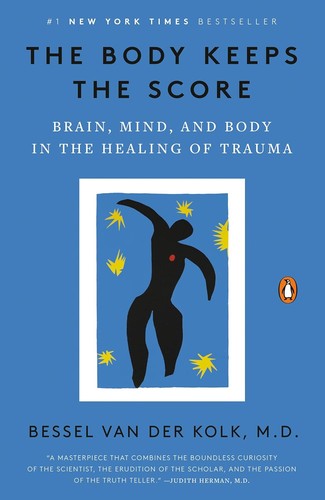
The Body Keeps the Score is technically a trauma book— but its core argument is about a dimension of self-awareness most other books never address: the body’s own knowledge.
Psychiatrist and Boston University researcher Bessel van der Kolk’s central insight is this: trauma (and this includes the everyday relational and career stress that accumulates over time, beyond acute PTSD) reshapes the nervous system in ways that interrupt the natural capacity for self-awareness. The body stores patterns and information that the conscious mind can’t access through thinking alone.
If you’ve ever noticed your chest tighten in a meeting without knowing why— that’s somatic data that precedes cognitive self-awareness. Van der Kolk’s book teaches you to read it.
As he writes: “In order to change, people need to become aware of their sensations and the way their bodies interact with the world around them.” That’s a form of self-knowledge that none of the other books on this list fully addresses.
What this means practically: If self-awareness-focused reading hasn’t been enough, your nervous system may be holding patterns your thinking can’t yet access. The body stores experience in its own language, separate from conscious thought.
If you’ve read five self-awareness books and still feel stuck, this is probably the one you haven’t tried.
Best for— People who’ve done therapy or reading but still feel disconnected from their own reactions. And anyone recovering from burnout or chronic stress.
The last two books take a different approach entirely— less about understanding the self and more about watching it.
Books for the Observing Self
Both of these books build on a single insight: you can step back and watch your inner experience without being absorbed by it. One approach is more practical, one more philosophical. But both develop that watching capacity.
The Untethered Soul by Michael Singer
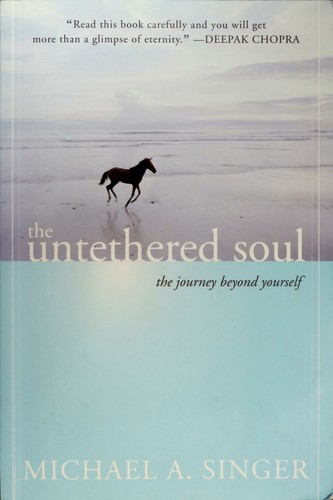
The Untethered Soul by Michael Singer has been on bestseller lists for 15+ years. The core insight is simple and practical even if the vocabulary skews spiritual: there is a voice inside your head that never stops talking, and you are the one who notices it.
Singer calls this the “inner roommate”— the constant mental commentary most people are so identified with that they don’t realize it’s observable from a distance. That distance is the essence of self-awareness.
This complements the psychological books on this list in a useful way. Eurich, Goleman, and David work from the outside in— research leads to practice. Singer works from the inside out. He’s asking you to notice the noticer.
Best for— Readers who’ve done cognitive and emotional work and want the contemplative layer. And readers drawn to mindfulness or meditation.
A New Earth by Eckhart Tolle
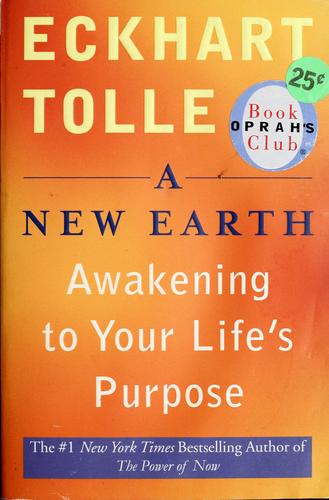
A New Earth by Eckhart Tolle (selected for Oprah’s Book Club, with more than five million copies sold in the US) addresses self-awareness at the level of ego— how we unconsciously identify with roles, possessions, grievances, and status in ways that limit what we can see about ourselves.
His “pain body” concept describes the unconscious accumulation of emotional pain that replays and reacts without our awareness. Being able to observe it is the first step out of it. And most people have no idea they’re doing it.
A New Earth is more abstract than The Untethered Soul. Readers new to contemplative territory may want to start with Singer first. But for people who’ve done psychological work and keep noticing the same patterns in relationships or work, Tolle offers a layer of explanation that’s hard to find elsewhere.
Best for— Readers who’ve completed psychological self-awareness work and want to understand ego patterns at a deeper level.
Self-Awareness Books vs. Self-Help Books: What’s the Difference?
Most of what you’ve read so far is about developing self-awareness. But a word on what it isn’t— because choosing the wrong category of book is how people spend years reading and still feel stuck.
Self-awareness books develop your capacity to see what’s actually happening inside you— your emotions, patterns, beliefs, and reactions. Self-help books typically tell you what to do with that knowledge.
This distinction matters more than most people realize. You can read twenty habit books and still be mystified by why you keep reverting. The gap is almost always self-awareness. Atomic Habits is a great book— it belongs in the self-improvement category.
Here’s how the three categories break down:
Self-awareness books develop the capacity to see yourself clearly in real time— what you’re feeling, how you’re reacting, what’s running below the surface. That’s what this list is.
Self-discovery books address the longer journey— who am I, what are my values, what’s my calling. If that’s what you’re after, there’s a separate list of self-discovery books that goes deeper.
Self-improvement books assume you already have self-knowledge in place and want to change specific behaviors. For that, the self-improvement books list is more on point.
Self-awareness is the prerequisite. Most self-help assumes you already have it.
A few more questions come up when people are choosing between these books— here are the direct answers.
Frequently Asked Questions
Here are the most common questions about books on self-awareness— with direct answers.
What is the best book to improve self-awareness?
Insight by Tasha Eurich is the most research-backed starting point— built on approximately 800 studies and 5,000 participants. For a contemplative approach, The Untethered Soul by Michael Singer is the most sustained bestseller in the category. If emotional self-awareness is specifically what you’re working on, start with Emotional Agility by Susan David.
New to Audible? You can start a membership trial and listen to it.
How does self-awareness differ from self-discovery?
Self-awareness is the real-time skill of seeing yourself clearly— your emotions, reactions, and patterns as they’re happening. Self-discovery is the longer journey of understanding your values, calling, and identity. Self-awareness is the prerequisite: you can’t navigate your life’s direction clearly if you can’t see what’s happening inside you right now.
What percentage of people are self-aware?
About 10–15%, according to Tasha Eurich’s research with approximately 5,000 participants— despite 95% of people believing they are. The gap exists partly because familiarity feels like clarity. Knowing your story and seeing yourself clearly are two different things.
Is emotional intelligence the same as self-awareness?
Self-awareness is the foundational component of emotional intelligence. In Daniel Goleman’s framework, all other EI competencies (self-regulation, motivation, empathy, social skills) require self-awareness as the base. You can only develop emotional intelligence if self-awareness is already solid.
What is internal vs. external self-awareness?
Internal self-awareness is knowing your own values, emotions, patterns, and reactions. External self-awareness is knowing how others experience you. Tasha Eurich’s research found these two are uncorrelated— strong internal awareness says nothing about how you land on others, and vice versa.
Where to Go From Here
Books on self-awareness give you language and frameworks for what you’re working with. But language alone doesn’t change how you react in a meeting or why you keep hitting the same wall in relationships.
The gap Tasha Eurich documented doesn’t close through reading. It closes through practice. Reading narrows it. Practice is how you move on it.
The most direct bridge is a regular reflection practice. If you want the research on what actually works, the article on how to develop self-awareness covers the specific practices with evidence behind them. And if you want a structured daily tool, a self-discovery journal is the most consistent way to turn reading into something that sticks.
Pick one book. Read it. Then practice what it teaches. That’s the whole thing.